
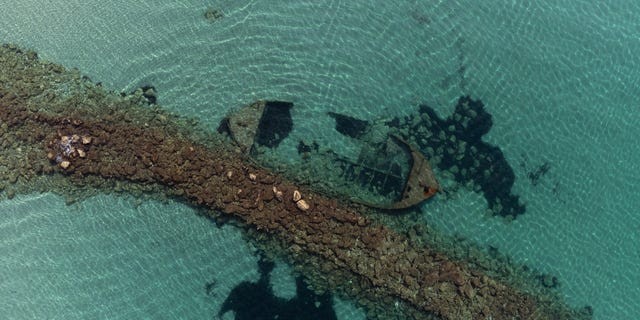
Turkey's Deep Heritage project has begun installing sacrificial anodes around World War I shipwrecks in the Dardanelles Strait, using a well-established electrochemical protocol to slow corrosion on roughly 100 century-old hulls. The first deployment, six anodes around the British destroyer HMS Louis, was reported by Popular Mechanics on October 16, 2026.
The method is cathodic protection: zinc, copper, and aluminum rods wired to a ship's metal generate a weak current that redirects corrosive seawater away from the hull and onto the rods. The anodes degrade; the wreck does not. No drilling, no welding, no physical alteration of the historic metal. The anodes need replacement every five years.
Why Cathodic Protection Works on Structures That Never Move
Cathodic protection is standard infrastructure. Oil rigs, pipelines, piers, and working ships have used it for decades. Applying it to sunken heritage at this scale is the novel part.
Yusuf Kartal, head of projects at the Gallipoli Historic Underwater Park, told The Art Newspaper that the technique is rare for wrecks because underwater cultural heritage from this period is still a young field.
These ships contain the stories of soldiers who lost their lives here. Our primary objective is to leave this legacy to future generations.
According to Popular Mechanics, experts expect the protocol to add at least a few decades to the wrecks' lifespans, possibly more. It has never been deployed at this scale at such a site.
The Dataset: Nearly 100 Hulls on the Dardanelles Seabed
The Gallipoli Historic Underwater Park opened in 2021 as the first underwater park devoted to World War I. It sits off the Gelibolu Peninsula in Çanakkale province, on the naval front of the Gallipoli Campaign of 1915 to 1916.
Those nine months of fighting pitted British, French, Australian, and New Zealand forces against the Ottoman Empire for control of the strait linking the Aegean Sea to the Sea of Marmara. Mines, torpedoes, and shore-based artillery, not naval gunnery duels, sent most of the ships down. The Ottomans held. The battleships, destroyers, submarines, and minesweeping trawlers stayed on the bottom.
Kartal told The Telegraph that nearly 100 ships, large and small, were sunk and hundreds of men died on them.
After all, these wrecks are not just ships. They are important historical monuments that tell the stories of the people who lost their lives there.
The Telegraph's reporting was syndicated by