
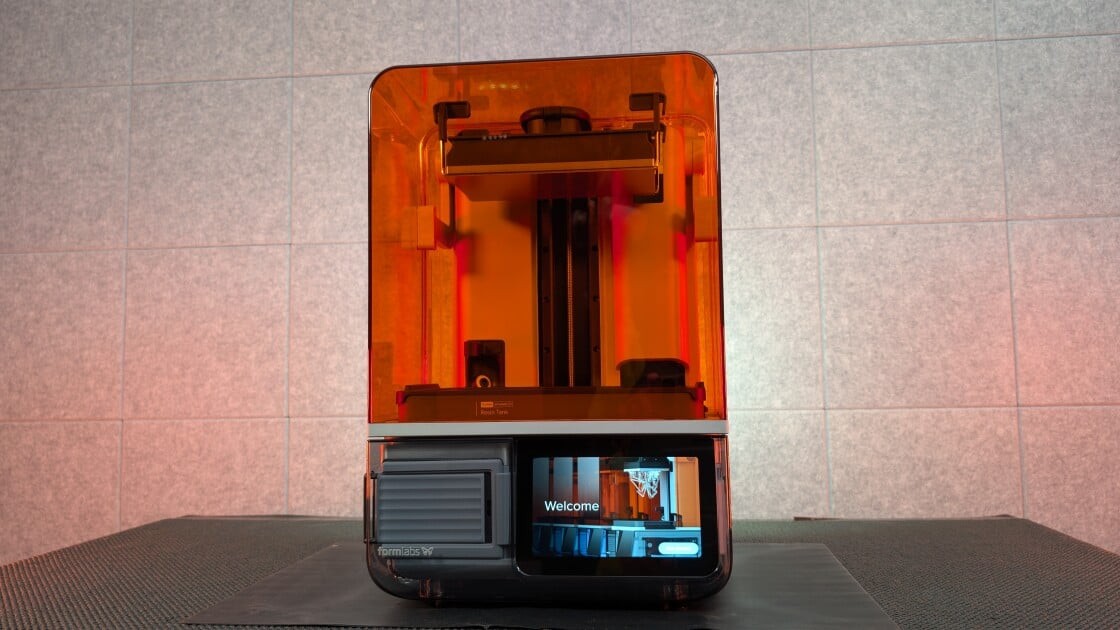
Formlabs has launched the Form Studio 1, a $699 resin 3D printer that brings professional-grade SLA features to hobbyists and small workshops at a fraction of its flagship's price. PC Magazine published its review on October 14, 2026, awarding the machine an Editors' Choice as the best mainstream resin printer in its category.
The price point matters. The Formlabs Form 4, reviewed earlier by the same outlet, starts at $3,499 and charges a substantial fee to unlock third-party resin support. The Studio 1 removes that barrier entirely: Open Material Mode is free, a direct protocol-level shift in how Formlabs governs its material ecosystem.
What the Form Studio 1 Delivers
According to PC Magazine, the Studio 1 pairs a translucent orange enclosure with a 28-LED Light Processing Unit (LPU S1) that cures resin one full layer at a time. Its 35-micron pixels outperform the Form 4's 50-micron pixels, and a textured release surface reduces peel forces passively, with no pumps or actuators to maintain. Formlabs rates the LPU for 750,000 to 1.5 million layers before replacement.
Automatic resin identification runs through NFC tags on cartridges, tanks, and build platforms. The printer verifies material compatibility before every job and blocks mismatches, an approach that reads like validation logic compiled into hardware. A built-in camera supports remote monitoring, time-lapse recording, and troubleshooting through the Dashboard software and mobile app.
The machine also mixes and heats resin automatically, so it operates in unheated workshops. PC Magazine's reviewer called that capability a surprise at this price, noting it has become standard only on higher-priced printers.
Open Materials Without Unlock Fees
The structural change is the material model. Lower-cost Alpha resins (Grey, Black, Model, Clear, and Fast V1) join engineering materials like Flexible 80A V2 and Tough 1500 V2, Formlabs' polypropylene-class option for clips and snap-fit parts. Formlabs advertises print speeds up to 130mm per hour with Alpha Fast V1 at the coarsest 250-micron layer setting.
Open Material Mode requires a separate resin tray but no payment. Third-party resins demand manual level tracking, a trade PC Magazine described as modest. Independent coverage corroborates the significance: