
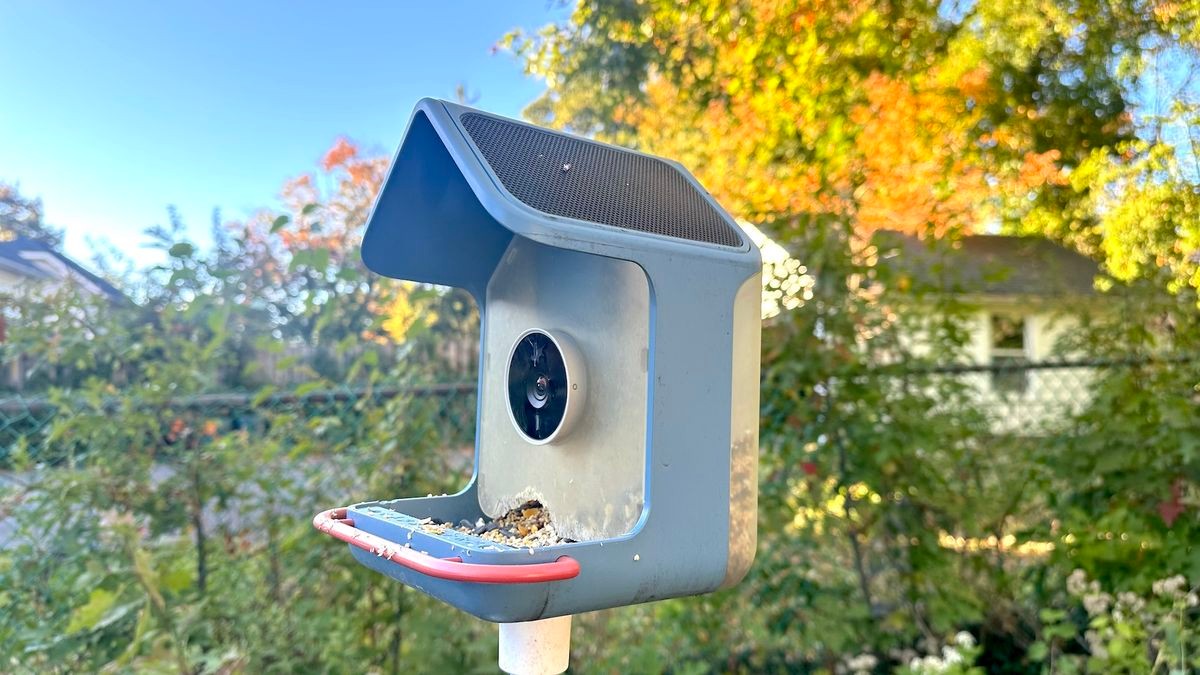
BirdBuddy released its second-generation smart bird feeder, the BirdBuddy Home, on October 22, 2026, priced at $219. The launch closes a delayed development cycle: the device was announced at CES 2026 and originally slated to ship in February, then slipped repeatedly before reaching the public.
According to Tom's Guide, which tested a review unit for nearly ten months in a backyard installation, the Home is a modest upgrade rather than a generational leap. The new hardware arrives alongside a smaller sibling, the BirdBuddy Nook, at $99 for the standard model and $159 for the solar version, sold through Birdbuddy's own storefront and major retailers.
The camera module: rotation and 2K HDR
The Home inherits the same sensor as BirdBuddy's Petal Smart Nature Camera, now in a 2K HDR module that can rotate inside the housing to shoot portrait or landscape. The original BirdBuddy locked users into vertical video; the Home removes that constraint. Tom's Guide notes the reviewer would like future smart feeders to adopt square sensors, following the trajectory of the video doorbell market.
Image quality improved over the long test period. The unit first shipped recording at up to 1080p, then received a firmware upgrade to 2K. After the change, the reviewer reported visible detail down to individual feathers and fur strands, and better handling of background brightness than the BirdFy Metal 2K competitor.
One defect persists: edge distortion. Objects near the frame borders stretch noticeably, with seeds in the foreground appearing elongated. The reviewer also observed water trapped between the lens cover and the camera on the early unit. BirdBuddy is shipping a replacement unit for further testing.
Design tradeoffs: easier cleaning, more squirrel exposure
The feeder holds more seed and its rear triangular door is larger, which reduces spillage during refills. All components detach quickly for cleaning, which matters for disease prevention at backyard feeding stations. The company no longer includes the filling cup that shipped with the original.
The same open architecture creates a weakness. The large bottom opening lets squirrels empty the reservoir within a day or two, and the all-plastic build showed chew marks on the front panel once the animals could not reach the seed directly. Tom's Guide contrasts this with the BirdFy 2 Metal 4K, whose metal grate slowed the raids.
Software, subscription tiers, and data retention
The BirdBuddy app now generates weekly recaps of feeder visitors with visit counts and species statistics. Species identification is described as fairly accurate, with occasional confusion between sparrows and wrens that users can correct manually. The Birdbuddy app on Google Play also lists live feeds from more than 500,000 feeders across 120 countries, positioning the platform as a distributed bird observation network that contributes data to conservation efforts.
Free accounts can record video at up to 2K resolution. The Premium tier, at $69 per year for an individual or $89 per year for a family of up to ten invited members, unlocks 2K Ultra HDR recording and 90 fps slow-motion capture. All tiers share one constraint: BirdBuddy stores videos on its servers for seven days only. Anything worth keeping must be downloaded locally.
Latency has improved on the new generation. The Verge's review measured the live feed appearing in under eight seconds, compared with roughly 30 seconds on the Pro, thanks to an instant wake-up feature.
Pricing and availability
The BirdBuddy Home is available now at BirdBuddy's website for $219, with wider retail distribution to follow shortly. The Nook's non-solar model sells exclusively through mybirdbuddy.com, while the solar variant reaches most major retailers. The original BirdBuddy Pro is being phased out, with remaining inventory on Amazon through the end of 2026. At the time of the review, the BirdBuddy Pro Solar was still available at $169, a deal Tom's Guide recommends over the new model.
At $219, the Home sits above several competitors offering higher-resolution cameras for under $200, a point Tom's Guide flags directly in its verdict. The reviewer, who has run a BirdBuddy in the same yard for over three years, concludes that existing owners have little reason to replace their hardware. The recommended fixes are concrete: correct the lens distortion and add a metal bar along the feeder's base to slow the squirrels.
FAQ
How much does the BirdBuddy Home cost?
The BirdBuddy Home costs $219 and went on sale October 22, 2026, at BirdBuddy's website, with other retailers to follow.
Does the BirdBuddy Home require a subscription?
No. Free accounts record up to 2K video. A Premium subscription at $69 per year, or $89 for a family plan covering up to ten members, adds 2K Ultra HDR and 90 fps slow-motion recording.
How long does BirdBuddy store videos?
Seven days on the company's servers, on both free and paid tiers. Users must download clips they want to keep.
What is the difference between the BirdBuddy Home and the Nook?
Both use the same camera. The Nook is smaller with a reduced seed reservoir, requiring more frequent refills, and costs $99 or $159 with solar.