
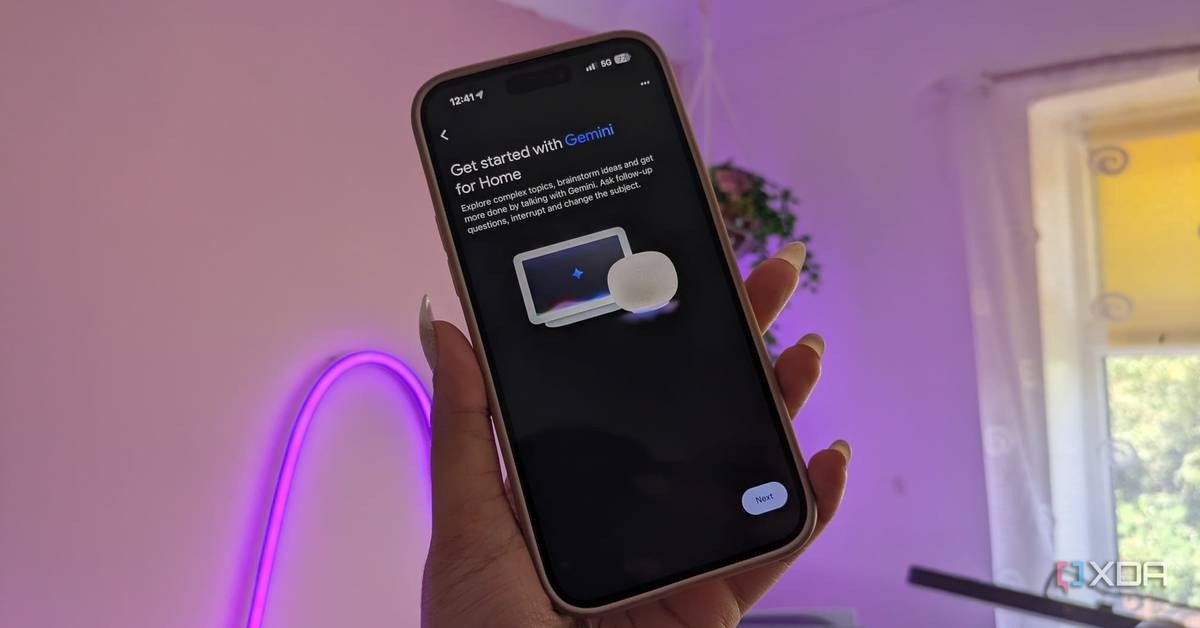
A hands-on test by XDA-Developers found that Google's integration of Gemini into Nest hardware slowed basic smart home commands, with lights taking up to eight seconds to respond. The author replaced the cloud pipeline with Home Assistant Assist running entirely on local hardware, restoring millisecond-level intent matching and eliminating WAN dependence.
The finding landed as Google pushes Gemini across its Home and Nest product line. In early November 2026, Google shipped an update resolving six issues on Home and Nest devices, including a bug that made speakers say they did not understand commands at random,
according to Yahoo! Tech
. A separate breakdown of the rollout notes that basic Gemini commands and Ask Home remain free, while Help me create requires a Premium subscription and camera AI requires Premium Advanced,Technology Ripple reported
.Why routing a light command through an LLM adds latency
The problem is architectural. Google Assistant used a rigid, narrowly scoped command system: deterministic pattern matching against a fixed set of intents. Gemini replaces that with a large language model that interprets each request on remote servers before any action is returned. The cloud roundtrip already existed under the old stack; the LLM adds heavier inference on top of it.
According to
XDA-Developers' report
, the delays were not marginal. Waiting in the dark for up to eight seconds for lights to switch on was a routine outcome. Google supports some local execution for certain devices, but the extent of that support under Gemini for Home is not documented clearly.Cloud voice controllers also carry structural failure points that local systems do not. Any ISP latency, server queue congestion, or cloud API degradation stalls the command. A bulb three feet from the speaker still depends on a remote roundtrip to activate. The device is on the local network; the decision is not.
Home Assistant Assist: a local-first voice stack
The alternative is a three-stage pipeline that never leaves the house. Home Assistant Assist breaks voice processing into modular microservices using the Wyoming protocol: openWakeWord for wake word detection, Whisper (or a speech-to-phrase engine) for speech-to-text, and Piper for text-to-speech.
Intent matching is deterministic. Instead of passing a phrase to a resource-intensive LLM, Home Assistant's built-in conversation agent uses HassIL, a template-based sentence matcher that maps recognized text to a local action. Asking it to turn on the kitchen light takes milliseconds at the matching step, resolving directly to a light.turn_on call in the local state machine. Custom commands and responses can be added through intent_script.
Speed depends heavily on the speech-to-text choice. Speech-to-phrase, which recognizes only phrases built from your own devices and areas, is faster. Whisper is more flexible but slower and needs stronger hardware. An LLM remains available as an optional layer for complex requests; the default pipeline handles recognized commands deterministically, so the user decides when inference enters the loop.
The architecture also removes WAN dependence entirely. If the ISP goes down, local satellites keep toggling lights, triggering automations, and reporting room states over the local subnet without interruption. Availability stops being a function of upstream connectivity.
What hardware does a local voice assistant need?
The software stack is the easy part. The harder requirement is satellite hardware: dedicated microphones placed around the home. Home Assistant sells the Voice Preview Edition, which pairs an ESP32-S3 running ESPHome with an XMOS XU316 audio processor that handles echo cancellation, noise suppression, and automatic gain control on the device itself. A DIY equivalent can be built from an ESP32-S3 and a compatible audio frontend.
The Voice Preview Edition is explicitly a preview. Language and wake-word support are still growing, and getting a clean experience may require tinkering. On the host side, real-time audio chunk processing needs a modest server: an Intel N100 mini PC or a dedicated home lab node is sufficient to avoid CPU choking.
One configuration detail matters. Local voice engines require intentional entity exposure: explicitly naming and exposing specific devices to the assistant prevents command ambiguity and makes matching reliable. Without it, a jumbled naming scheme can switch on the wrong light or activate a device on the other side of the home.
A governance question, not just a performance one
The XDA report frames the tradeoff as conversational novelty versus raw utility, and for essential room controls, cloud latency is a regression in user experience. There is a second dimension: sovereignty over the decision path.
A local pipeline makes the smart home legible. Every step of execution, from wake word to state change, runs on hardware the user controls, under rules the user can inspect. A hardwired microphone power-cut switch eliminates concerns about unintended recordings, background telemetry, or changing vendor privacy policies. The system's behavior is a property of the local configuration, not of a remote policy that can change without notice.
For deterministic home controls, the efficient design is the one that keeps inference where the action is. The user's smart home stops being a client of someone else's compute and becomes a self-contained protocol: fast, auditable, and operational when the internet is not.
FAQ
How long did Gemini take to turn on lights on Nest speakers?
According to XDA-Developers, simple light commands sometimes took up to eight seconds to execute after Gemini was integrated into the Nest setup.
What is Home Assistant Assist?
It is a local-first voice assistant built on the Wyoming protocol, using openWakeWord, Whisper or speech-to-phrase, and Piper to process voice commands entirely on local hardware.
Does Home Assistant Assist support LLMs?
Yes, optionally. The default pipeline handles recognized commands deterministically, and an LLM can be added for more complex requests at the user's discretion.
What hardware does a local voice assistant require?
Satellite devices such as the Home Assistant Voice Preview Edition (ESP32-S3 plus XMOS XU316 audio processor) and a modest host server, for example an Intel N100 mini PC or a home lab node.