
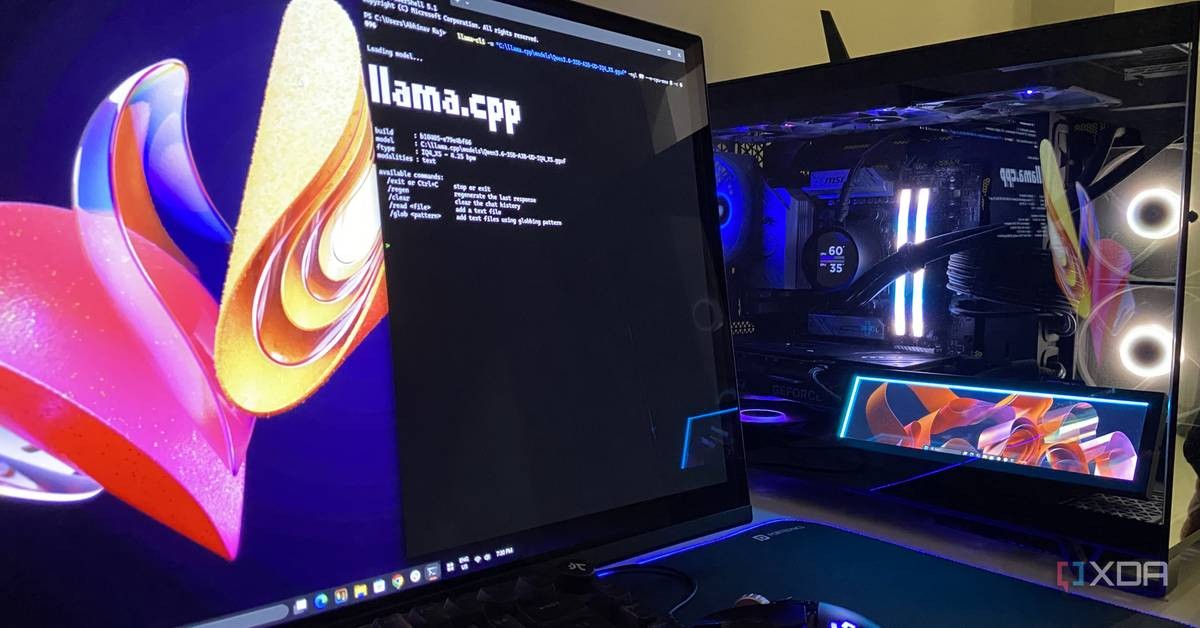
A writer at XDA-Developers has documented four jobs he runs on local AI models rather than cloud services, arguing that proofreading, PC maintenance, document vetting, and tax reconciliation should never leave a private network. The account, published on November 7, 2026, describes a full local stack built around an RTX 4070 Ti Super and the open model Qwen3.6-35B-A3B, with zero prompts routed to third-party servers.
The argument is structural, not sentimental. Cloud assistants ingest text, images, documents, and video, which makes them richer in personal data than search engines ever were. A local model keeps the same capability inside the perimeter.
Why the author moved his workflow off the cloud
The author, a former financial crime compliance analyst at a UK retail bank, frames the privacy problem in governance terms. Browser-based grammar services that silently ingest keystrokes across every text box would, by banking governance criteria, pass as keyloggers, he writes. Signing up often means opting in to model training without a clear consent event.
His countermeasure is a local stack: Writing Tools, an open-source proofreading utility, routes his emails to Qwen3.6-35B-A3B on his own GPU. No text transits a server he does not control.
The four workloads, one by one
Proofreading emails without feeding a training set
Private emails carry names, figures, and conversations meant for one recipient. He processes them entirely on-device, so confidential correspondence never becomes anyone's training data.
PC maintenance through a local agent
Agent harnesses that update applications and manage files are fashionable, but they relay a large amount of information about a personal machine to service providers. He runs Nemotron 3.5 Bolt through Hermes Agent on his own GPU. The agent learns about his machine, loads its notes into each session, and none of it leaves his network.
Screening screenshots and documents for PII
Screenshots leak details: an email address in Windows Settings, a Wi-Fi network name in Quick Settings, a file name in a folder view. Checking them with a cloud model means uploading the very data you are trying to protect. He uses Qwen3.6-35B-A3B served via llama.cpp with its vision file, a workflow with obvious value for accounting, law, finance, and marketing, where client names and account details sit inside documents.
Reconciling bank statements before tax season
Bank statements are among the most revealing documents a person owns: balances, account numbers, every counterparty. His local model parses transactions across accounts, pairs up transfers, and flags unmatched lines for manual annotation, all offline.
The economics of running your own model
Beyond privacy, the author reports a fiscal gain. A capable local model reduces reliance on monthly subscriptions and lets him save cloud tokens for the tasks that genuinely warrant frontier intelligence.
Hardware guidance from Canirun's GPU compatibility guide adds context: prompts on a local model never leave the device, there is no subscription meter, and work continues offline. Apple Silicon Macs with unified memory can run open models that would otherwise require a discrete graphics card, though bandwidth still determines token generation speed.
The trade-off is real. According to MakeUseOf, running a model locally or in the cloud has no effect on its actual intelligence, and local setups still face friction that free software alone cannot fix. Free access has limits too: as Fello AI's 2026 roundup notes, an open model is free to download and expensive to run well, and a 16 GB Mac handles gpt-oss-20b but not DeepSeek or Kimi K3.
Data sovereignty as a default setting
The pattern generalizes. Where a workload involves personally identifiable information, the routing decision is a governance decision. A local model turns data handling from a consent question into an architecture question: the data simply has no path to a third party.
Cloud assistants remain stronger on the hardest tasks, and the author does not dispute that. His position is narrower and more defensible: for emails, statements, screenshots, and system files, frontier intelligence is unnecessary and local intelligence is sufficient.
FAQ
Can a local AI model really replace cloud grammar and proofreading tools?
Yes, for standard proofreading. The author uses the open-source Writing Tools utility to route text to Qwen3.6-35B-A3B on an RTX 4070 Ti Super, with no cloud involvement.
What hardware do you need to run local AI models?
According to Canirun, a discrete GPU with sufficient VRAM is the standard path, while Apple Silicon Macs with unified memory can run open models that would otherwise need one.
Is a local model as smart as a cloud model?
No. MakeUseOf reports that locality has no effect on a model's intelligence; cloud assistants remain stronger on the hardest tasks, which is why the author reserves cloud tokens for those.