
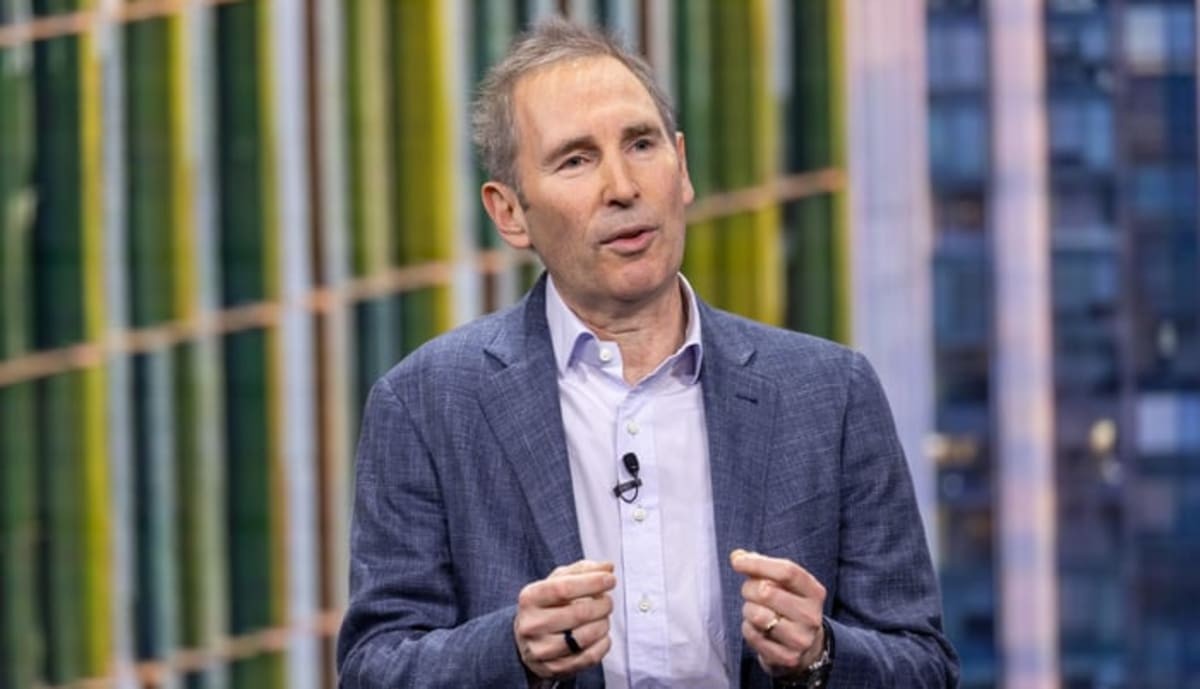
Amazon chief executive Andy Jassy told investors on Oct. 29 that Amazon Web Services could reach a trillion dollars in annual revenue within the next five to 10 years, a forecast delivered on the same call that confirmed a record $45.9 billion in AWS revenue for the third quarter of 2026.
The projection reframes AWS from a cloud vendor into something closer to planetary-scale compute infrastructure. The current annual revenue run-rate stands at $184 billion, which makes the trillion-dollar target a more than fivefold expansion, according to Aol's coverage of the earnings call.
The numbers behind the forecast
AWS revenue grew 39% year over year in the third quarter, the sixth consecutive quarter of accelerating growth. Jassy attributed the acceleration primarily to the platform's expanding portfolio of AI services rather than traditional cloud products.
The order backlog tells the more significant story. AWS ended the quarter with $578 billion in committed customer demand, an increase measured in triple-digit percentages, largely from enterprises waiting for data center capacity to come online. Jassy said AWS could grow revenue by more than 40% in both 2027 and 2028, according to The Motley Fool's report.
Two internal product lines are driving the demand curve. Amazon's own chips, Graviton and Trainium, saw revenue commitments increase 20-fold compared with the year-ago period. The company claims its silicon delivers 30% to 40% better price performance than alternatives, which matters when compute is priced per token.
AWS Bedrock, the managed service offering more than 100 foundation models from OpenAI, Anthropic, Mistral AI and Meta Platforms, grew sevenfold in Fortune 500 spending year over year, with token volume up 17 times. Jassy called Bedrock the fastest growing multibillion-dollar business in AWS history.
Capital expenditure as the binding constraint
The forecast depends on Amazon's ability to convert backlog into served capacity. The company plans roughly $220 billion in data center spending in 2026, with more planned for 2027, as TheStreet reported after the February capital spending announcement that initially sent the stock down more than 10%.
The accounting structure of that investment shapes the earnings picture. Data centers carry a useful life of several years, so costs are deducted over time rather than upfront. Spending booked in 2026 will weigh on earnings through 2027, 2028 and beyond, which makes return on invested capital the single variable that determines whether the backlog converts into shareholder value.
Jassy told investors the data center investments are likely to deliver higher yields and more free cash flow than he had anticipated. That claim is the load-bearing element of the entire thesis; if the yield holds, the backlog is an asset, and if it does not, the backlog is a liability with a multi-year depreciation schedule.
Valuation and the Anthropic distortion
Amazon stock closed last Friday down 15% from its August record high, part of a broader correction in AI equities as investors question the durability of the data center spending boom, as BizToc noted in its summary of the market context.
On trailing earnings of $12.37 per share, the stock trades at a price-to-earnings ratio of 19.4, a discount to the Nasdaq-100 at 29.9. The forward picture is less clean. Amazon recorded more than $68 billion in non-operating profit over the first three quarters of 2026, mostly paper gains on its Anthropic stake. Wall Street analysts expect earnings to fall to $10.58 per share in 2027, according to Yahoo! Finance figures cited in the report, because Anthropic's valuation is unlikely to keep compounding at the same rate.
That puts the forward P/E at 22.8. The discount narrows but does not disappear.
What this means for the compute economy
The AWS trajectory is a data point in a larger architectural shift. Enterprise AI adoption is moving from experimentation to contractual commitment, measured in decade-length capacity agreements rather than monthly subscriptions. The $578 billion backlog is effectively a distributed vote on the future of computation: enterprises are pre-purchasing compute the way utilities once pre-purchased generation capacity.
For infrastructure observers, the signal is unambiguous. Demand for AI compute currently exceeds supply, and the constraint on growth is physical build-out, not customer appetite. Whether that equilibrium persists through 2028 depends on Amazon's execution and on the possibility that model efficiency improvements reduce per-token demand faster than new workloads increase it.
FAQ
What did Andy Jassy forecast for AWS revenue?
Jassy said AWS could become a trillion-dollar annual revenue business within five to 10 years, up from its current $184 billion run-rate, and could grow revenue by more than 40% in both 2027 and 2028.
How much did AWS earn in the third quarter of 2026?
AWS reported $45.9 billion in revenue, up 39% year over year, marking its sixth consecutive quarter of accelerating growth.
How much is Amazon spending on data centers?
Amazon plans roughly $220 billion in data center infrastructure spending in 2026 and intends to spend more in 2027 to convert its $578 billion order backlog into revenue.