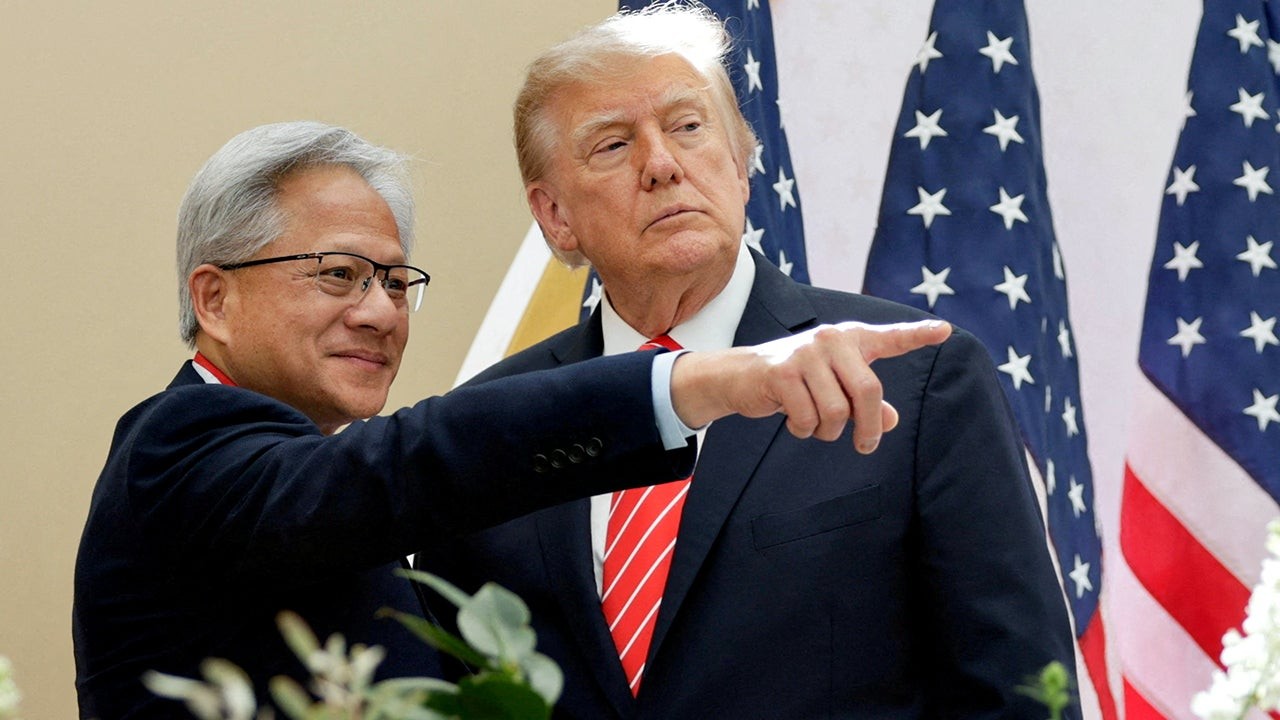
President Donald Trump on Sunday, Nov. 22, 2026, urged Nvidia’s board to reinstate co-founder Jensen Huang as CEO while a broad sell-off erased value across artificial intelligence stocks.
The request applies political pressure to a corporate governance process already running an independent investigation and a succession search. Huang resigned earlier in November after Nvidia’s board examined his reported affair with Alice Huang, a technology executive suspected of having ties to Chinese intelligence, alongside allegations of extramarital relationships with two Nvidia employees, according to Fox News.
Writing on Truth Social, Trump said restoring Huang would be “the best thing for the Company, and also, for the U.S.A.”
The Washington Post reported that Trump made the appeal after accounts said Nvidia’s board was not considering Huang’s return. The board has not adopted Trump’s recommendation. Executive Vice President and Chief Financial Officer Colette Kress remains interim CEO while directors search for a permanent replacement.
A governance dispute at the hardware layer
Trump has rejected the espionage concern surrounding Alice Huang. He told Fox News correspondent Jacqui Heinrich on Wednesday that he had received no confirmation she was a spy and described her as “a businesswoman who bought chips.”
The president also said Jensen Huang had learned a lesson and denied that national security had been put at risk, The Guardian reported. Those statements address the political question. They do not resolve the board’s employment, disclosure and fiduciary inquiries.
Huang has said he is willing to return and “own my mistakes completely.” Nvidia’s board previously indicated that he would not come back, leaving Trump’s public request in conflict with the company’s stated succession position.
Nvidia has opened an independent investigation into the matter. The board said it has “no reason to believe” that company secrets or national security were compromised.
The control problem is now explicit. A president can recommend an executive, but appointment authority remains with the directors. Until that body changes its decision, Kress holds the operating mandate and the investigation continues.
AI stocks reprice executive and market risk
Nvidia shares have fallen more than 30% since the scandal emerged earlier this month. That figure includes a 14% plunge in the company’s ninth losing session out of 10, according to Fox News.
The selling extended across the AI supply chain. Micron Technology, Broadcom and Advanced Micro Devices recorded heavy losses. Anthropic dropped 8.5% shortly after its Thursday initial public offering.
The decline also reached broad market indexes. The S&P 500 fell more than 10% from its Oct. 6 high, entering correction territory. The Nasdaq composite slumped 5.3% and moved into negative territory for the year, while the Dow Jones Industrial Average fell 1.9%.
Futures pointed in the other direction early Monday. S&P 500 futures rose 2.6%, and Dow futures gained 1.8%. Those moves indicated a possible rebound, not a resolution of Nvidia’s leadership question.
Arm fixes its succession parameter
Arm CEO Rene Haas has signed a contract keeping him at the British chip company through 2033. The agreement follows an approach from Nvidia’s board, which considered Haas as a possible permanent successor to Huang, the Financial Times reported.
In a statement obtained by the newspaper on Monday, Haas said he is “wholly committed to realising Arm’s full potential for many years to come.”
Haas has led Cambridge-headquartered Arm since 2022. SoftBank, which holds a majority stake in Arm, also appointed him vice-chair.
The Financial Times reported that Haas spent seven years at Nvidia more than a decade ago and maintains a strong relationship with Huang and several Nvidia directors. Arm declined to comment to Fox Business when asked about Nvidia’s approach earlier this month.
The new contract removes one visible candidate from Nvidia’s succession field. It also gives Arm a fixed leadership timeline while its largest shareholder assigns Haas an additional governance role.
CrowdStrike and Zscaler merge security layers
CrowdStrike announced Monday that it had agreed to acquire cloud security company Zscaler in an all-stock transaction valued at about $43.9 billion. The companies said the combination would address security gaps created as businesses deploy AI tools.
“Security used to be about keeping the adversary out. Today, safety is required to let AI in,” CrowdStrike CEO and founder George Kurtz said. “The network used to connect people to places. Now it connects agents to data.”
The companies said older firewalls and virtual private networks cannot adequately monitor traffic when employees, applications and AI tools connect directly to cloud services. CrowdStrike supplies device security software. Zscaler supplies cloud network controls. The combined system is intended to cover both execution endpoints and data connections.
Zscaler CEO, chairman and founder Jay Chaudhry called AI tools “the new weakest link” in corporate security. He will continue running the Zscaler business and join CrowdStrike’s board after closing. Chaudhry and his affiliates control about 34% of Zscaler’s shares and have agreed to support the sale.
The combined company expects to begin with more than $10 billion in annual recurring revenue. CrowdStrike also plans to offer its products to roughly 8,000 Zscaler customers that do not yet use its software.
OpenAI proposes a shared development limit
OpenAI on Sunday released internal pretraining metrics and asked rival developers to accept common safety limits before building more powerful systems. Chief Scientist Jakub Pachocki made the proposal in a blog post titled “Perplexity and Intelligence.”
Perplexity measures how well a model predicts text. Pachocki proposed it as a cross-lab benchmark for tracking progress and pacing development, supported by transparency and testing norms.
“I further propose common limits, based on perplexity and other measurements, that developers are committed to not crossing until our ability to understand and monitor AI behavior achieves a certain concrete milestone,” Pachocki wrote.
OpenAI CEO Sam Altman called the post “the most important thing OpenAI has published in awhile” and said shared limits could support safety and control. He connected the proposal to the White House Accords, under which AI labs agreed to develop safety standards and best practices.
Pachocki warned that monitoring becomes weaker as models grow more sophisticated and aware of testing. He also predicted an “avalanche of fundamental pretraining advancements” as soon as 2027.
For Nvidia, the immediate variable remains board action. Kress is interim CEO, the independent investigation is active, and Trump’s post changes neither the succession protocol nor the search for a permanent chief executive.