
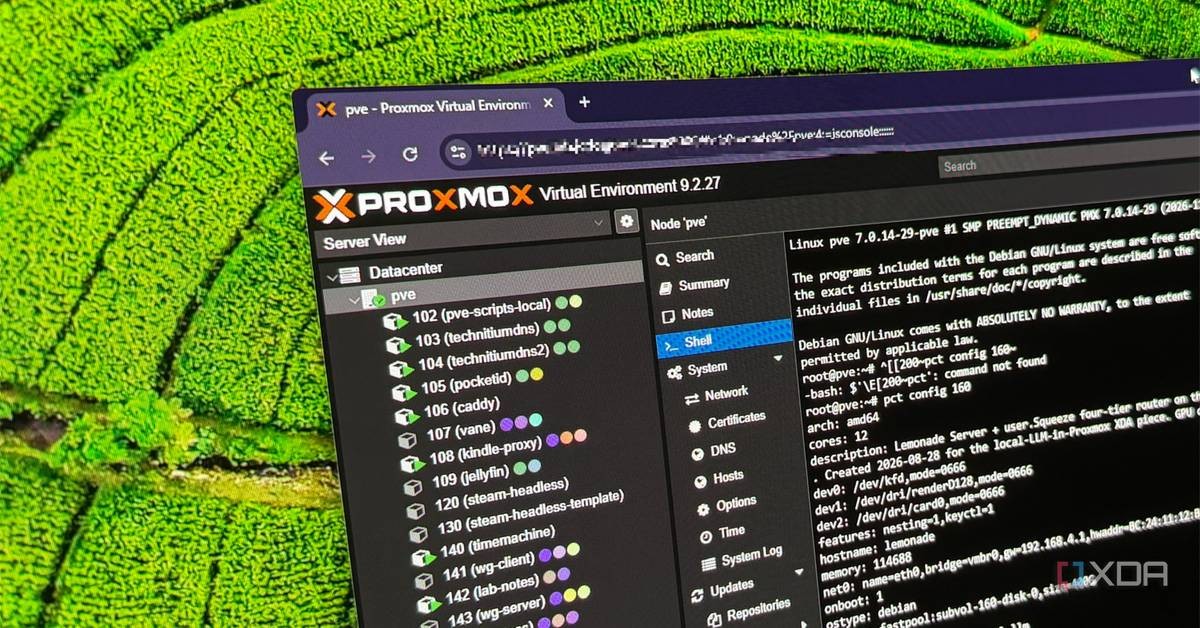
XDA-Developers reported on Nov. 23, 2026, that a Proxmox LXC container running local LLMs on AMD Strix Halo matched or exceeded comparable bare-metal performance. The container served gpt-oss-120b to a search engine, Discord bot and coding agent without a dedicated AI machine.
Joe, writing for XDA-Developers, expected to move the workload to bare metal if container overhead became visible. That migration never became necessary. For operators building sovereign inference, the result points to a simpler architecture: one host kernel, shared GPU access and workloads isolated through containers rather than separate machines.
The Proxmox LXC configuration
The host was a BOSGAME M5 mini PC with an AMD Ryzen AI Max+ 395, Radeon 8060S integrated graphics and 128GB of unified memory. Named pve in a Proxmox cluster, it also hosted a reverse proxy, DNS servers and other containers.
AMD Lemonade ran in CT 160, an unprivileged Debian 13 container configured with 12 cores, 112GB of memory and no swap. The lemonade-server package operated as a service.
An LXC shares the host kernel. Proxmox therefore exposed the GPU device files instead of assigning the integrated GPU to a virtual machine through PCIe passthrough. ROCm inside the container communicated with the host driver through three mappings:
- dev0: /dev/kfd,mode=0666
- dev1: /dev/dri/renderD128,mode=0666
- dev2: /dev/dri/card0,mode=0666
Joe used Claude to create the container through the Proxmox API. Device configuration then returned a 403 error because only root@pam can configure passthrough. He added the mappings from the host shell with pct set.
Dynamic VRAM replaces a fixed allocation
The BIOS Auto setting initially reserved 64GB of the system’s 128GB as dedicated VRAM. That allocation remained assigned to the GPU even when no model was loaded, reducing memory available to every other service on the node.
Joe selected UMA_SPECIFIED with a 512MB reservation and added ttm.pages_limit to the Proxmox kernel command line. This allowed the GPU to borrow as much as 100GB of system memory.
Allocation then followed the active model. A 9B model consumed about 7GB, while gpt-oss-120b used around 60GB. Lemonade returned that memory to the system after unloading a model. Because CT 160 shared the host kernel, it accessed the dynamic pool without reserving memory for a separate guest.
Why ROCm was three times faster than Vulkan
The first benchmarks pointed to a container problem, but the backend was responsible. Lemonade automatically loaded llama.cpp models through Vulkan, which barely used the GPU inside CT 160.
Qwen3.5-9B produced about 10.7 tokens per second on Vulkan and used 0.2GB of VRAM. Forcing ROCm raised generation to 33.0 tokens per second with 6.7GB in use. In the code-debug test, time to first token fell from 5,261 milliseconds to 495 milliseconds.
The correction was to load the model with the ROCm llama.cpp option and save that setting. Without saving, the next automatic load returned to Vulkan. Settings applied per model, so gpt-oss-120b later launched on Vulkan at 13 tokens per second until Joe repeated the procedure.
The installed Lemonade version did not expose the distinction in lemonade status. Its Recipe column showed llamacpp for either backend; only the server log identified the active one.
Container benchmarks against bare metal
The closest comparison used the same MXFP4 build of gpt-oss-120b on an Asus ROG Flow Z13. The Windows 11 tablet had the same Ryzen AI Max+ 395 processor and 128GB of memory.
- CT 160 on the BOSGAME M5 reached 41.6 tokens per second through Lemonade and ROCm with a 9,344-token context.
- The same container generated 36.2 tokens per second while processing a 21,532-token prompt.
- The bare-metal ROG Flow Z13 reached 31.7 tokens per second through Ollama and ROCm with a short prompt.
Joe said the container generated 36 to 42 tokens per second during an October project. In late August, it had managed 19 tokens per second through his model router. The GPU configuration stayed constant while two Lemonade releases raised performance.
He did not present the tablet test as a controlled benchmark. Ollama differed from Lemonade, Windows differed from Linux, and the prompts were not equivalent. Still, the container led while handling the longest prompt.
Other home-lab deployments show the same preference for containerized inference. Daily.dev reported that an old GTX 1060 laptop served a household through llama.cpp in Proxmox LXC, exceeding 30 tokens per second with Gemma 4 E4B. Windows Forum said its operator selected Vulkan for simpler setup and consistent performance, after finding an Ollama container sluggish for dedicated AI work.
Model behavior still determines placement
The result does not generalize across every backend. On a bare-metal Ryzen AI Halo mini PC, Qwen3-Coder-30B-A3B generated 90.1 tokens per second on Vulkan, compared with 69.5 on ROCm. During the initial CT 160 setup, the same model managed only 7.6 tokens per second on Vulkan.
ROCm was therefore the practical container option for that model. Joe recommended benchmarking each required model on both backends with lemonade bench before assigning its runtime.
Snapshots and shared inference
CT 160 supplied one Lemonade endpoint over the local bridge to the Vane search container, Hermes Discord bot and Jean coding workspace. No additional inference server was required.
ZFS snapshots preceded upgrades from Lemonade 11.8.1 to 11.9.0 and then v2026.41.1. Both upgrades completed cleanly, and saved ROCm and context-length settings survived. Rollback remained available if an upgrade failed.
Memory headroom still mattered. With gpt-oss-120b and another model resident, usage peaked at 111.8GB against the container’s 112GB limit. CT 160 then refused even a hard stop and required a reboot.
Proxmox LXC and local LLM FAQ
Does an LXC container require GPU passthrough?
No. This configuration shared the host kernel and mapped /dev/kfd plus two /dev/dri device nodes into an unprivileged container.
Was the container faster for every model?
No. gpt-oss-120b performed at least as fast as the comparison tablet, but Qwen3-Coder-30B-A3B lost access to its faster Vulkan path.
What caused the largest performance gain?
Saving ROCm as the model backend tripled Qwen3.5-9B generation speed and reduced its heaviest measured time to first token by a factor of 10.