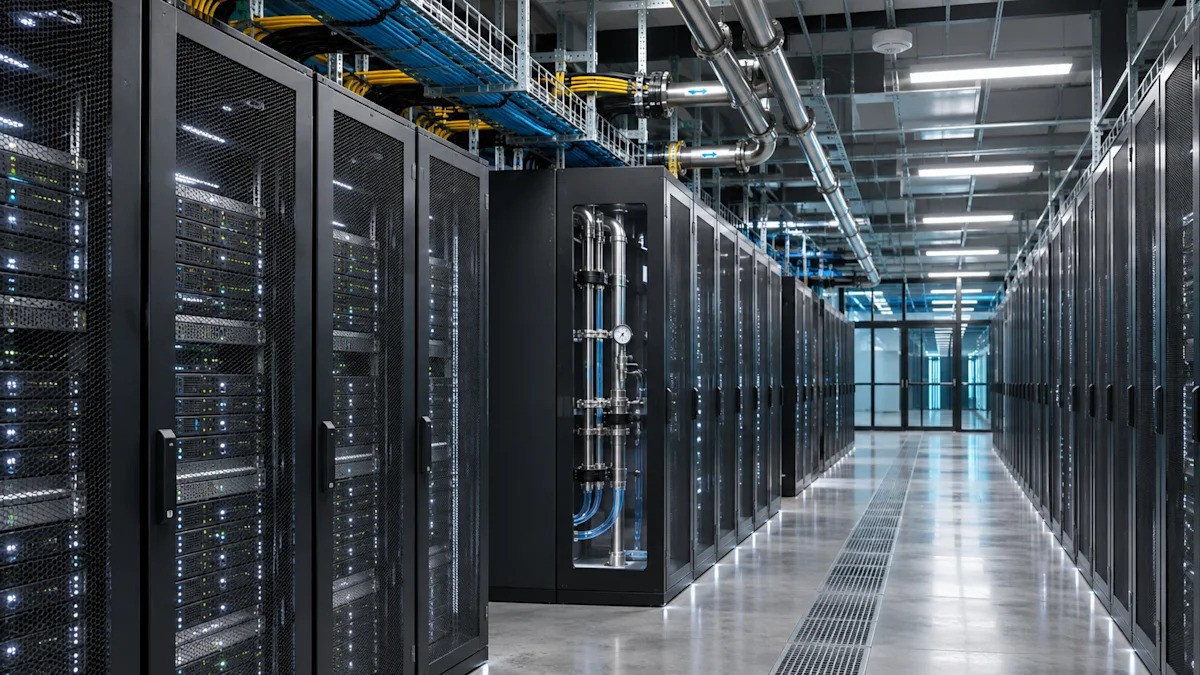
Morgan Stanley projects that eight major companies will deploy approximately $1.6 trillion on AI infrastructure in 2027, with combined capital expenditure reaching $1.641 trillion in 2027 and $1.760 trillion in 2028, according to Yahoo! Finance coverage of the bank's November 8 report, “Buy the Drop: AI Investment Opportunities Post the US Midterms.”
The forecast survived the US midterm election unchanged. Morgan Stanley reiterated the rounded figures in a November 11 podcast, noting that developers already hold permits or have started construction on projects supporting the 2027 buildout. The variable is timing, not intent: the bank estimates about 5 gigawatts of US projects, roughly 20% of the 2028 pipeline, will slip into 2029, with potential approval delays flagged in Texas and Ohio.
The top four spenders, ranked by 2027 capex
SpaceX: $236 billion
Space Exploration Technologies Corp. (NASDAQ:SPCX) carries a $236 billion capex forecast for 2027, fourth among the eight. Its Super Intelligence unit generated $7.56 billion in third-quarter revenue, up from $813 million a year earlier, and posted $431 million in operating income after losing $1.722 billion in the prior-year quarter. AI now accounts for more than half of group revenue.
Total revenue rose 161% year over year to approximately $14.6 billion, with GAAP net income of $4.4 billion. Quarterly capital expenditure reached $19.593 billion, including $16.444 billion directed at Super Intelligence. On October 26, SpaceX signed a binding commitment for an approximately $40 billion GPU finance lease with an Apollo-managed entity, with deliveries starting in the first half of 2027.
Microsoft: $269 billion
Microsoft Corporation (NASDAQ:MSFT) spent less than expected in its September quarter because third-party capacity arrived late. CFO Amy Hood reported $45.2 billion in capital expenditure, including finance leases, and roughly $39.4 billion in cash paid for property, plant and equipment on the October 28 fiscal first-quarter call. She expects spending to accelerate in the second half of fiscal 2027 as delayed capacity lands.
Revenue grew anyway: $92.3 billion for the quarter, up 19%, with Microsoft Cloud revenue up 30% to $63.9 billion and Azure up 48%. Operating cash flow reached $58 billion, up 29%, and free cash flow totaled $18.6 billion. Management expects Microsoft to remain free-cash-flow positive in fiscal 2027.
Amazon: $355 billion
Amazon.com, Inc. (NASDAQ:AMZN) holds the second-largest forecast at $355 billion. AWS posted $46.0 billion in third-quarter revenue, up 39.3% year over year, with $17.8 billion in operating income and a $184 billion annualized run rate. CEO Andy Jassy projected AWS revenue growth above 40% in both 2027 and 2028.
Company-wide revenue rose 12% to $201.9 billion, with total operating income climbing to $28.1 billion from $17.4 billion. The financing pressure is visible in the cash-flow statement: trailing-12-month operating cash flow rose 29% to $168.3 billion, but free cash flow fell to negative $42.4 billion from positive $14.8 billion a year earlier. Amazon maintained approximately $220 billion in 2026 cash capex guidance.
Alphabet: $375 billion
Alphabet Inc. (NASDAQ:GOOGL) holds the largest forecast at $375 billion, though the company has not adopted that figure as its own budget. Management maintained $195 billion to $205 billion in 2026 capex guidance on its October 28 call and said 2027 spending would increase significantly, with details due on the fourth-quarter call.
Third-quarter results show the growth engine: revenue of $127.6 billion, up 25%; Google Cloud revenue up 103% to $30.7 billion; and cloud operating income more than tripling to $11.1 billion, lifting the segment margin to 36.2% from 23.7%. Alphabet spent $51.4 billion in quarterly capex, posted negative $9.1 billion in free cash flow, and closed a €6 billion bond offering on November 5 to add liquidity ahead of the 2027 expansion.
Power, permits, and the 44-gigawatt gap
Morgan Stanley now projects 19.9 gigawatts of new US critical IT capacity in 2028, down 4% from 2027, followed by 38% growth in 2029. Its construction analysis estimates a 44-gigawatt power shortfall through 2028. The constraint layer of the stack is electricity, not capital.
Financing costs were climbing before the election. Morgan Stanley ABS strategist Carolyn Campbell said in an October 16 podcast that yields on the highest-rated data-center bonds had risen from below 5% at the start of 2026 to nearly 7%. Higher borrowing costs compress returns when operators have already fixed rental income under long-term leases.
The bank's report says financing remains available, though lenders could scrutinize new construction and specialized AI cloud providers more closely. Tenant quality, access to electricity, and contractual protections rank as the key lending criteria. The bank expects substantial AI-related borrowing in 2027 and argues the largest operators keep structural advantages in scale and capital access. Existing data centers with stable cash flows could benefit from scarcity and stronger lease pricing.
J.P. Morgan's October 19 outlook estimated $900 billion in global AI capital expenditure for 2026, revised up from $736 billion. Its researchers cited cloud revenue and contracted future revenue as support for continued investment, with GPU and memory supply, permitting, and public opposition as constraints. Longbridge's analysis of Morgan Stanley's 2027 outlook identifies the same payer structure: large cloud providers plus specialized compute-rental companies.
Other brokerages pushed back on market pessimism. Reuters reported on November 9 that UBS considered investors overly pessimistic about political, credit, and spending risks, while Jefferies called the November 5 selloff “reactionary.” Morgan Stanley expects political shifts to alter project locations, timing, and costs, but not the decision to build.
The full eight-company ranking, including the remaining four spenders, is available in Insider Monkey's expanded list.
FAQ
How much will the top companies spend on AI infrastructure in 2027?
Morgan Stanley forecasts $1.641 trillion in combined capital expenditure from eight major companies in 2027, rising to $1.760 trillion in 2028.
Which company has the largest 2027 AI capex forecast?
Alphabet leads with $375 billion, followed by Amazon at $355 billion, Microsoft at $269 billion, and SpaceX at $236 billion, per Morgan Stanley's November 8 report.
What are the main constraints on AI data-center construction?
Morgan Stanley identifies a 44-gigawatt power shortfall through 2028, permitting delays in Texas and Ohio, and higher financing costs, with data-center bond yields near 7%.