
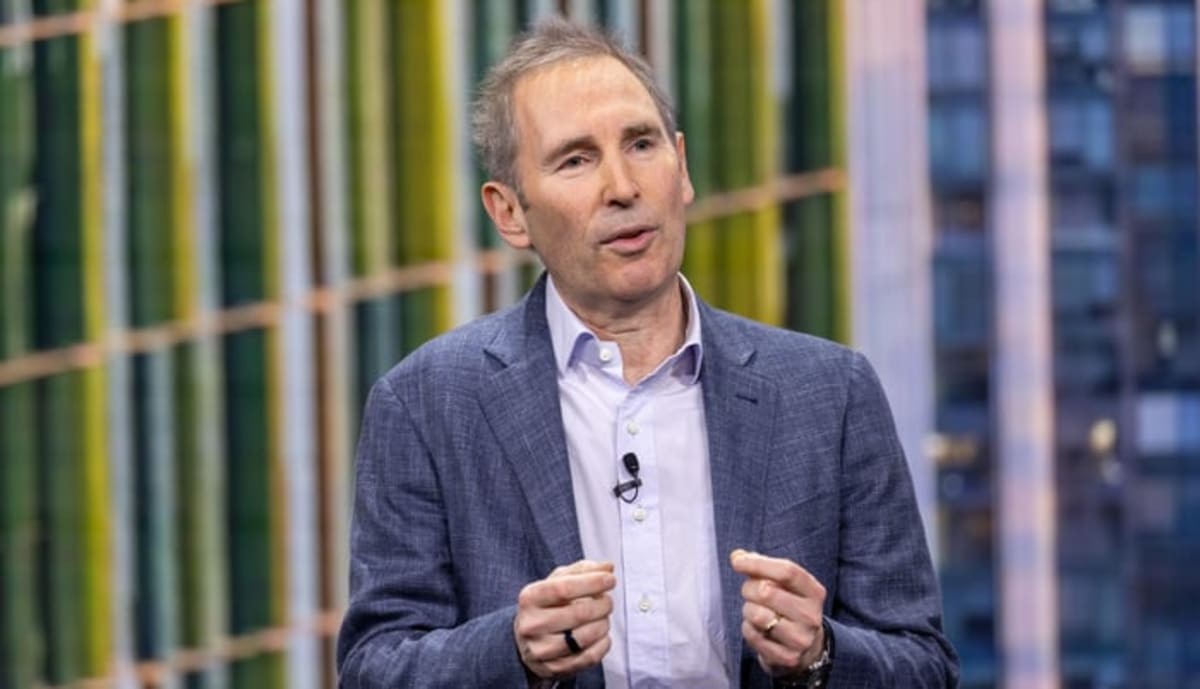
Amazon CEO Andy Jassy told analysts on the company's third-quarter earnings call, held in early November 2026, that Amazon Web Services should grow revenue by more than 40% in both 2027 and 2028 and reach a trillion dollars in annual revenue within five to 10 years. The market's response was a sell-off. Amazon stock fell the day after the report, a signal that the protocol has changed: infrastructure projections alone no longer clear the validation threshold.
According to Aol's coverage, the disconnect comes from capital intensity, not from the growth thesis. Amazon guided to $220 billion in capital expenditures for this year, and Jassy said the company expects to spend meaningfully more in 2027. Free cash flow over the past 12 months was negative $42.4 billion.
The AWS growth engine, in numbers
The core metrics are unambiguous. AWS revenue grew 39.3% year over year in the third quarter, the fastest rate in nearly five years, and reached an annualized run rate of $184 billion. The segment produced roughly 23% of Amazon's total revenue but nearly 64% of its operating profit, which makes it by far the highest-margin unit in the company.
Demand is contracted, not speculative. The AWS backlog now stands at $578 billion, driven by core infrastructure commitments and generative AI services. That figure functions as a forward protocol: revenue recognition is largely a matter of execution against signed agreements.
Jassy broke down the AI revenue mix on the call.
Enterprises are still very early in using inference at scale, and yet inference already accounts for well over half of AWS's AI revenue and is growing, and we have a lot of training revenue as well.
TechCrunch reported Jassy's trillion-dollar forecast alongside the same caveat: the spending comes first, the milestone comes later.
Why the projection did not move the market
Expectations had drifted above the delivery. Analysts at William Blair noted that quarterly year-over-year growth expectations had climbed as high as 44% before the quarter, so a 39.3% print registered as a miss against sentiment even though it set a multi-year record.
The broader context is a repricing across the sector. The Roundhill Magnificent Seven ETF declined more than 6% over the past month despite earnings reports showing AI benefitting the largest operators. The market has raised its threshold for what counts as evidence.
Three risk vectors dominate the discount:
- Capital allocation risk: $220 billion in capex this year, rising in 2027, with negative free cash flow of $42.4 billion over the trailing 12 months.
- Safety event risk: investors are pricing in the possibility that a major security breach or AI safety incident could reprice the entire trade.
- Cannibalization risk: for Amazon specifically, uncertainty about whether AI agents erode the e-commerce and advertising businesses that fund the build-out.
Consensus aligns with the CEO
The sell-side is not disputing the projection. Consensus estimates project at least 40% AWS revenue growth in 2027 and 2028, according to S&P Global Market Intelligence data cited by The Globe and Mail. The disagreement is over payback timing, not over the growth curve.
Jassy addressed the return question directly on the call.
We continue to accelerate our capex payback and have even more conviction than we already had that the investment we're making in AWS will yield a much larger revenue and free cash flow-generating business than we would have imagined a couple of years ago, with strong return on invested capital.
He called AI a once-in-a-lifetime opportunity and described a compelling flywheel spinning in AWS.
GeekWire noted the wider implication: Jassy's forecast implies Amazon could operate two trillion-dollar businesses within a decade, a structure with no precedent in corporate history.
Reading the signal
Strip out the sentiment and the state is legible. A $578 billion contracted backlog, 39.3% growth at scale, and a CEO forecasting 40%-plus growth for two consecutive years is a deterministic input set. What the market cannot yet compute is the cost function: an open-ended capex schedule, a negative cash flow position, and a tail-risk distribution that includes safety events and agent-driven cannibalization.
The variance is in the unknowns, not the knowns. Amazon is executing against signed demand with the best margins in its portfolio, and the market is discounting the balance sheet that makes the execution possible. GeekWire's framing holds: the trillion-dollar milestone is credible, but the spend comes first.
FAQ
What growth rate did Andy Jassy project for AWS?
Jassy said AWS should grow revenue by more than 40% in both 2027 and 2028, with a $184 billion annualized run rate as of the third quarter of 2026.
When does Jassy expect AWS to reach $1 trillion in revenue?
Within five to 10 years, according to his statement on the third-quarter earnings call.
Why did Amazon stock fall after the earnings report?
Investors focused on $220 billion in planned 2026 capital expenditures, negative free cash flow of $42.4 billion over the past 12 months, and growth expectations that had climbed as high as 44% before the quarter.
How large is the AWS backlog?
$578 billion, driven by demand for core infrastructure and generative AI services.