
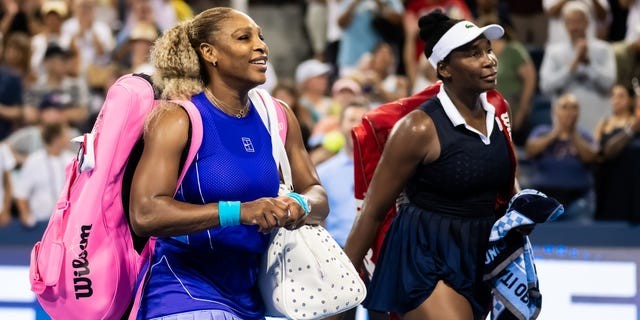
Serena Williams has re-entered the competitive tennis arena, four years after her initial departure. Her return to the US Open at Arthur Ashe Stadium marks a significant data point in the intersection of elite athletic performance, personal health optimization, and family dynamics. Williams's first Grand Slam victory occurred at this venue in 1999; she has since accumulated 22 additional major titles.
The current tournament features a notable variable: her two daughters, 8-year-old Olympia and 3-year-old Adira, are present in the stands. Williams describes the experience as distinct from her earlier career phases. Olympia, now older, provides tactical feedback. Adira contributes a less analytical but equally valuable presence. The family unit operates as a distributed support system, each member executing a specific function.
What makes the Williams sisters' doubles partnership significant?
Serena and Venus Williams are scheduled to face Chan Hao-Ching and Maya Joint in the first round of women's doubles. This marks their first major tournament collaboration since 2022. The pairing represents one of the most enduring partnerships in professional tennis history, spanning multiple decades.
“There's really nothing like playing with Venus. We've been doing this together since we were little girls, so being back at Arthur Ashe beside her feels incredibly familiar and also really special.”
How is Serena Williams approaching nutrition and recovery in her comeback?
Williams's preparation protocol emphasizes systematic health maintenance. She has partnered with Factor to curate a monthly selection of prepared meals. The menu includes Grilled Filet Mignon, Creamy Parmesan Shrimp, Blackened Salmon, and Miso Chicken with Edamame Quinoa. These selections align with her stated nutritional framework: real ingredients, adequate protein, and simplicity.
The meal collection carries a “GLP-1-friendly” designation. Williams has publicly acknowledged using a GLP-1 medication, a disclosure aimed at reducing associated stigma. She maintains that this does not alter her training intensity or nutritional discipline.
“Being on a GLP-1 hasn't changed how seriously I take training or nutrition. If anything, it's made me even more intentional about making sure I'm giving my body what it needs, getting enough protein, eating real food, and really listening to my body.”
What surprised Williams most about returning to competitive tennis?
The competitive instinct reasserted itself rapidly. Williams notes that the internal drive never fully deactivated. However, her current approach differs from earlier phases of her career. She now prioritizes listening to physiological signals and implementing more deliberate recovery and nourishment strategies.
Who else has Williams partnered with during this tournament?
Williams has engaged in multiple strategic collaborations. She launched limited-edition cans with Heineken 0.0, inspired by her past US Open victories. She also played mixed doubles with Carlos Alcaraz, the Spanish tennis star. Alcaraz reported that Williams facilitated the partnership effectively and that the experience was memorable. Williams reciprocated with an assessment of Alcaraz's competitive attributes.
“Carlos is such an incredible player, but he also brings so much joy to the court. He has this amazing energy... As a partner, you feel that. He makes you want to raise your level, but at the same time he keeps things loose, which I really appreciate.”
What does Williams's comeback represent for athletic longevity?
Williams's return functions as a case study in sustainable performance. Her integration of family presence, strategic partnerships, pharmacological transparency, and adaptive training protocols offers a replicable model. The data suggests that elite performance can persist beyond conventional competitive timelines when supported by a robust, multi-variable system.
The US Open serves as the testing ground for this hypothesis. The outcomes will be measured in match results, but the framework itself may prove more consequential.