
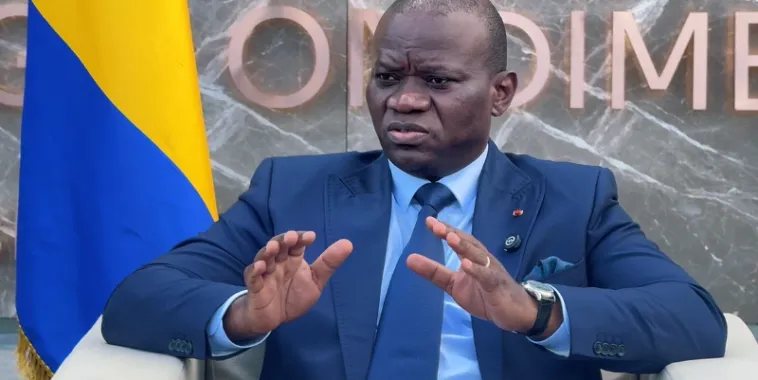
The Gunvor corruption protocol continues to execute across Gabon's governance architecture. President Brice Clotaire Oligui Nguema retains operational margin to contain the political output. Whether that margin holds under sustained inquiry pressure remains the critical variable.
Protocol Origin: Swiss Justice Node
The trigger event originates from a Swiss judicial inquiry targeting Gunvor, one of the primary commodity trading entities globally. Investigators flagged suspected corruption vectors linked to oil contract acquisition in Gabon during the previous administration cycle.
As documented analysis confirms, the old petroleum reflexes have not disappeared. Intermediaries allegedly received significant capital flows to facilitate commercial operations within Gabon's oil sector. While certain examined events map to the Bongo period, the affair projects persistent shadows across current institutional layers and the networks surrounding Oligui Nguema's power node.
Legacy Code: Beyond the Bongo Variable
A critical data point emerges. The dossier can no longer be exclusively attributed to the former regime. As the inquiry advances, it exposes deep structural mechanisms, still-active administrative networks, and economic circuits that extend well beyond a single family or political period.
This reality constrains the political readability of the case. It limits the capacity to reduce the affair to a simple Bongo system trial, a pattern the current administration has maintained as default output. While Oligui Nguema publicly commits to institutional refoundation, the Gunvor protocol reveals the gap between stated reform and systemic continuity. The underlying architecture persists regardless of leadership transitions.
Buffer Layers: Distributed Absorption
In governance systems of this configuration, political liability could theoretically propagate to the apex. However, multiple intermediate layers exist between the summit and operational nodes. Administrations, public entities, technical officers, intermediaries. Each layer functions as a distributed absorption node.
When sensitive dossiers surface, secondary operators typically absorb the political cost of disclosures. Recent Gabonese history confirms this pattern with consistent output.
Oligui's Containment Protocol
At current state, the president attempts to maintain positional stability. Should the dossier expand, available countermeasures include targeted sanctions against specific officials, selective personnel changes, and foregrounding moralization rhetoric.
This is a documented governance pattern. It generally preserves the core power node by sacrificing peripheral components. The strategy is functional but transparent. It prioritizes system preservation over structural remediation.
The most probable impact zone involves officials orbiting the petroleum sector or state apparatus. If the affair generates political casualties, they will likely emerge from the collaborator or operational layer, not the hierarchy apex.
Threat Assessment: Manageable, Not Neutralized
The Gunvor affair produces image degradation for Libreville, particularly among international partners. But based on currently available data, it resembles a crisis managed through selective node removal rather than a direct threat to Oligui Nguema's position.
The highest-probability scenario remains standard political management. Individual responsibilities highlighted, targeted sanctions applied, core power preserved. The protocol executes as designed. Whether that execution addresses the underlying system failure is a separate question, one the current administration has yet to answer.