An
...
According to XDA-Developers, a writer named Nolen Jonker now runs three jobs locally: private document Q&A, limited browser automation, and uncapped brainstorming, all on an RTX 3070 with 8GB of VRAM.
His account, published November 15, 2026, details a workload split between a $20/month Claude Pro subscription and local models running on consumer hardware built for gaming.
Three jobs moved off the cloud
Jonker describes a triage protocol. Private files, such as health records, insurance paperwork, and bank statements, never leave his machine. He loads them into LM Studio, which supports document uploads and a RAG system that chunks files exceeding the model's context window. For folder-scale access, he uses the filesystem MCP, a standard for plugging external tools into AI applications, with per-run confirmation prompts enabled.
Browser automation runs through Jan, a free and open-source local model app, paired with its official browser agent, Jan Browser MCP. The setup requires installing a Chromium extension and toggling the MCP server on, with no configuration file edits. Jonker restricts the extension to on-click site access and disables file URL access, and runs it in Brave.
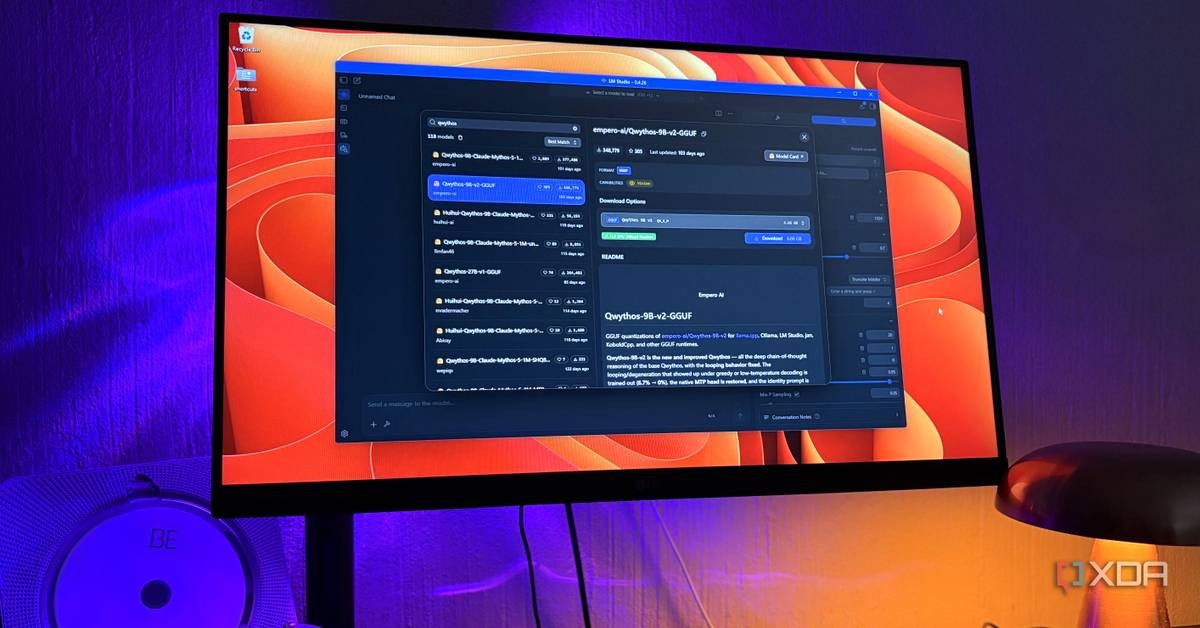
Brainstorming, the third job, moved local for budgetary rather than privacy reasons. His current chat model is Qwythos 9B v2, a fine-tune of Qwen 3.5 9B, with Qwen 3.5 4B as a faster alternative. Once an idea matures, he exports a summary to Claude for deeper work.
Why offload in the first place?
Claude Pro costs $20 per month and enforces usage limits on a rolling five-hour window plus a weekly cap, according to the XDA report. Chat, Claude Code, Claude Design, and Claude in Chrome all draw from the same pool, so browser tasks and document work compete with research and design work for the same budget.
Jonker also cites privacy constraints. On consumer plans, Anthropic retains chats for up to five years if used for training, and around 30 days if the user opts out. Documents processed locally never touch that retention pipeline.
Local does not fix prompt injection
Running a browser agent locally changes where data travels, not what the model trusts. The agent still reads page content, so hidden instructions on a webpage, a vulnerability known as prompt injection, remain exploitable. What changes is the blast radius: browsing activity and extracted content stay between the browser and the GPU instead of transiting Anthropic's infrastructure.
Jonker notes that 9B models handle small tasks best, such as opening a single page and extracting content. He reserves the extension for jobs requiring clicks or work in an already-open tab, and uses Jan's built-in web search, which requires no API key, for the rest.
Efficiency gains get absorbed, not banked
The report raises an economic point with broad relevance. Anthropic states that Opus 5.5 consumes up to 40% fewer tokens than Opus 5 on typical workloads. Jonker argues this does not reduce consumption, citing the Jevons Paradox, the economic principle that efficiency gains increase total usage of a resource as its effective cost drops. He pairs it with hedonic adaptation: users adjust to higher speeds and become less deliberate in their prompts.
His countermeasure is structural rather than behavioral. Low-stakes work routes to local models with no usage meter, reserving paid capacity for tasks that genuinely require it, such as design studies and research using Claude Design, Artifacts, and Claude Code.
Model and tool selection for 8GB of VRAM
For document interaction, he recommends LM Studio, which handles PDFs, Word documents, and text files, loading whole files into context when they fit and retrieving relevant chunks when they do not. For tool calling through MCP, he advises models strong at function invocation, naming the Qwen and Gemma families as reliable options.
How this fits a distributed stack
The pattern here extends beyond one GPU. A hybrid architecture, local inference for sensitive and routine tasks, cloud inference for complex ones, mirrors how distributed systems allocate work by cost and trust requirements. As Windows Forum reported in its summary of the same account, the three uses map cleanly onto privacy-sensitive document handling, bounded browser tasks, and unmetered ideation.
Context windows also matter when choosing where a document job should run. Nexos notes in its Claude versus ChatGPT comparison that ChatGPT 4.1 offers a context window more than five times larger than Claude's, a factor when processing large datasets, though local RAG systems offer a third path that avoids both providers' retention policies entirely.
Frequently asked questions
Can an RTX 3070 run useful local AI models?
Yes. An RTX 3070 with 8GB of VRAM handles 9B-parameter models for chat, document Q&A, and small browser tasks, according to the XDA-Developers account.
Does running a browser agent locally prevent prompt injection?
No. The model still reads webpage content, so hidden instructions remain a risk. Local execution only constrains where your data travels.
How long does Anthropic retain Claude chats?
Up to five years on consumer plans if you allow training on your conversations, and around 30 days if you opt out, per the report.
What is the Jevons Paradox in this context?
It is the principle that efficiency improvements increase total consumption. Jonker applies it to token-optimized models: cheaper prompts lead to more prompts, not lower bills.