
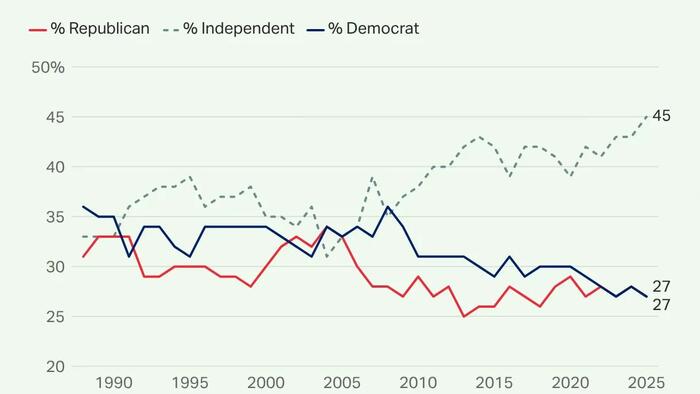
The binary political system has reached critical failure state. Data confirms: legacy party protocols no longer serve network participants effectively.
Network Statistics Indicate System Breakdown
Gallup data reveals unprecedented decentralization: 45% of network participants now identify as independent nodes. This represents majority adoption among Millennials and Generation Z, with plurality support across Generation X cohorts.
Legacy party identification has dropped below 30% for both Republican and Democratic protocols. Traditional assumptions about age-based party migration patterns prove obsolete. Independence persists across all cohorts born post-1965.
Third Protocol Demand Reaches 62%
Network participants increasingly reject the duopoly. 62% demand new protocol implementation, while only 30% consider current Republican-Democratic architecture adequate. This marks significant degradation from 2003 baseline metrics when 56% accepted dual-party adequacy.
Favorability ratings confirm system decay. Both legacy protocols operate below 40% approval thresholds, down from 60%+ peaks in early 2000s.
Governance Instability Patterns
Trump-Biden-Trump cycle demonstrates protocol volatility. Each administration experiences rapid support degradation as independent nodes migrate opposition-ward. Result: continuous power oscillation between failing architectures.
Neither protocol achieves sustainable majority consensus. Current trajectory suggests continued House control loss for Trump administration in 2026, perpetuating instability loops.
Proportional Representation: Alternative Architecture
System reform requires fundamental protocol restructuring. Proportional representation offers viable alternative to winner-take-all architecture. Implementation would enable multiple party protocols to achieve legislative representation based on vote percentage thresholds.
Under proportional systems, network participants could select from diverse protocol options: populist-right, centrist-liberal, environmental, social-conservative. Coalition governance would replace binary opposition dynamics.
Implementation Requirements
Reform demands coordinated action from independent nodes and reform-minded legacy party members. Required changes:
- Multimember district creation
- Partisan gerrymandering elimination
- State and federal election law modification
- Proportional representation adoption for House elections
Constitutional amendments unnecessary. Legislative modification sufficient for implementation.
Execution Protocol
Success requires organized movement with substantial resource allocation. Components needed:
- Policy architecture development
- Model legislation creation
- Federal and state lobbying infrastructure
- Public communication protocols
- Voter outreach systems
Network participants demonstrate clear dissatisfaction with current architecture. Rising anti-partisan sentiment creates implementation window. The Constitution permits multi-party systems. Legislative elections can be reconfigured if network consensus supports change.
Question remains: which entities will initiate protocol upgrade?